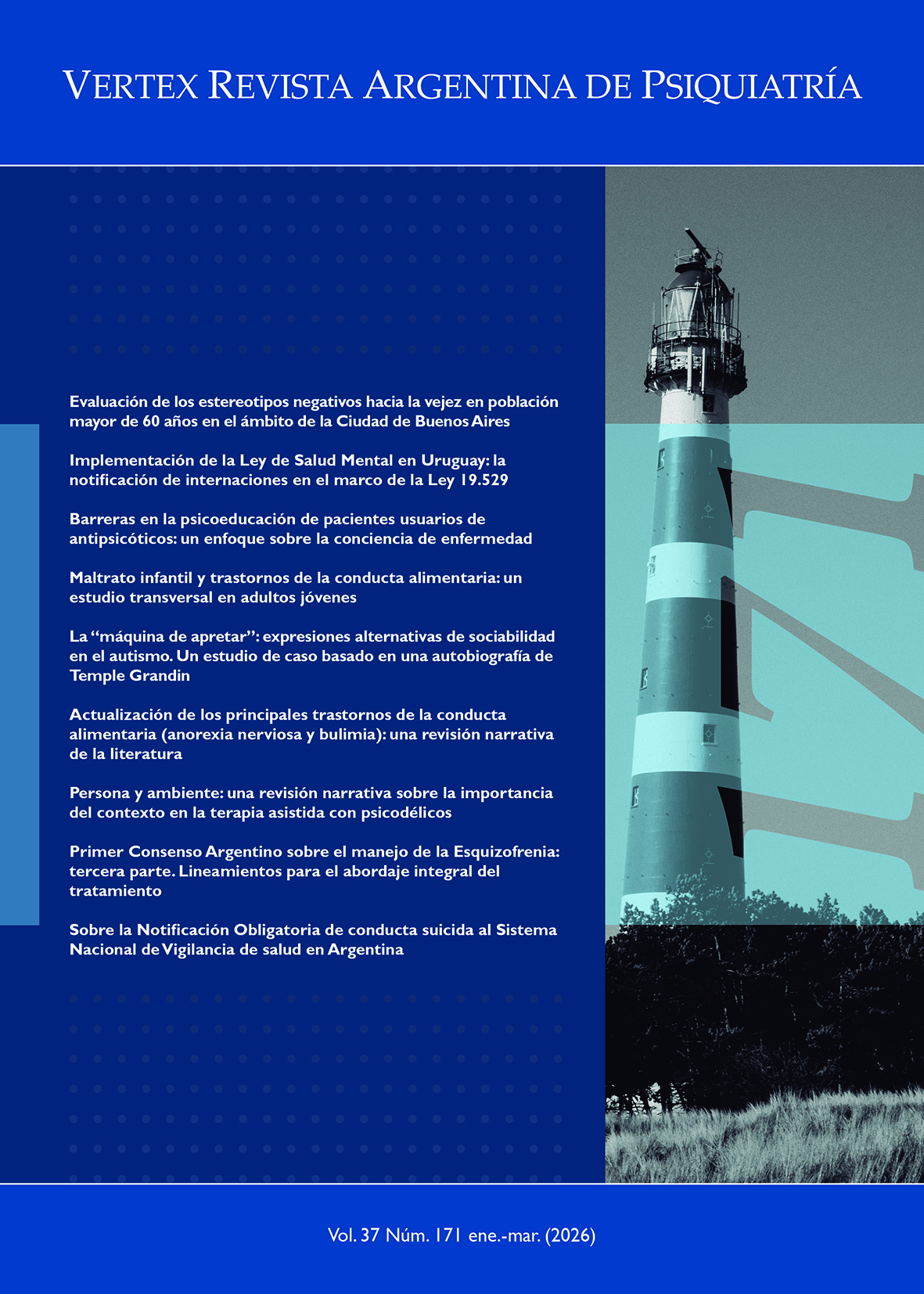
The "squeeze machine": alternative expressions of sociability in autism. A case study basedon an autobiography by Temple Grandin
DOI:
https://doi.org/10.53680/vertex.v37i171.976Keywords:
autism, Temple Grandin, autobiography, case study, alternative expressions of socialityAbstract
The socio-communicational alterations involved in the phenomenon of autism make it difficult for those who experience
it—both autistic and non-autistic individuals—to identify what they feel and want from their relationships. The work of psychiatrist Marcelo Pakman on the singularity of sense in the field of mental health provides the theoretical and methodological framework that underpins this research, which, through a qualitative approach and a case study design, aims to inquire into and present singularities—atypical situations that facilitate the construction of relationships by taking advantage of unconventional opportunities for social connection. This is explored in the autobiography of Temple Grandin "Emergence: Labeled Autistic", specifically focusing on the experience of inventing the "squeeze machine", also known as the "hug machine." The book identifies the existential openings promoted by this experience, as they foster other ways of being with others by disrupting the rigid patterns that sustain some of the stereotypes associated with the clinical diagnosis.
Downloads
Downloads
Published
How to Cite
Issue
Section
License
Copyright (c) 2026 Viviana López Torres

This work is licensed under a Creative Commons Attribution-NonCommercial-NoDerivatives 4.0 International License.